2025
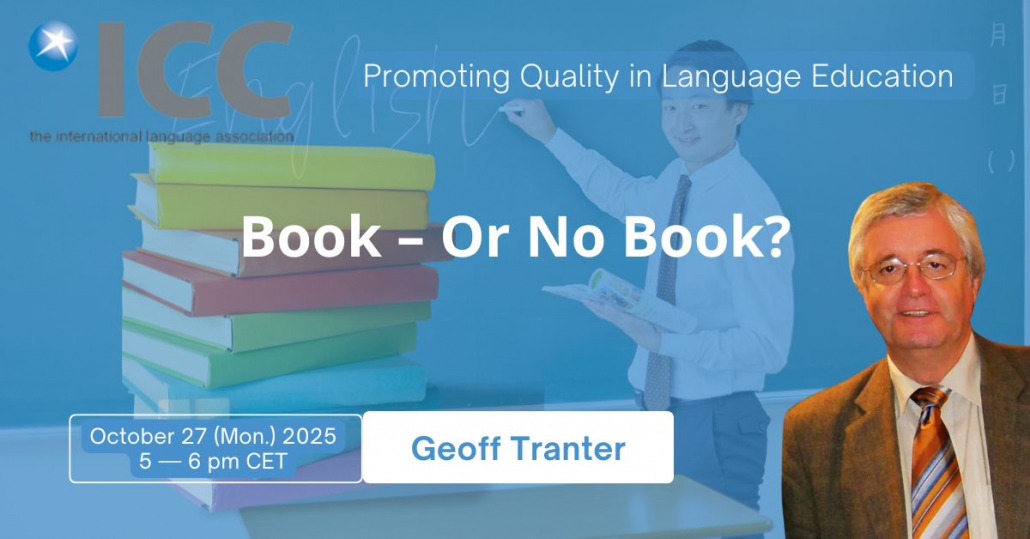
Geoff Tranter | Book – Or No Book?
October 27 (Monday) 2025 | 5:00-6:00 pm CET
read more
Abstract:
This is a question that teachers are often confronted with when taking on new courses. And there are good arguments for and against both alternatives. At lower levels such as A1/A2, coursebooks are the standard answer simply to offer a transparent structure. As from B1 however, there are a number of good reasons why teachers should consider not using a coursebook but provide their own materials to meet their learners’ needs and interests. In this session we will be discussing suitable materials and looking at strategies that will ensure that the aims and objectives of the course are fulfilled. The takeaway will be a matrix to enable teachers to plan both the whole course and the individual lessons in a way that meets the interests of the teacher and the students.
This webinar was originally planned for July.
Bio:
Geoff Tranter is a Teacher, Teacher Trainer and Consultant at the Technical University of Dortmund, Germany, specialising in English for Specific Purposes, including Engineering, Social Sciences, Business Communication Skills and English for Urban Planning. He is also Chair of the Anglo-German Society in Dortmund, and is working on promoting the city partnership between Dortmund and Leeds and bringing together groups of like interests such as schools, senior citizens and people from the creative arts. One of his particular interests is humour and how to use humour in the classroom to promote language learning and intercultural competence. He has published two books on this topic which offer photocopiable materials for use in EFL courses.
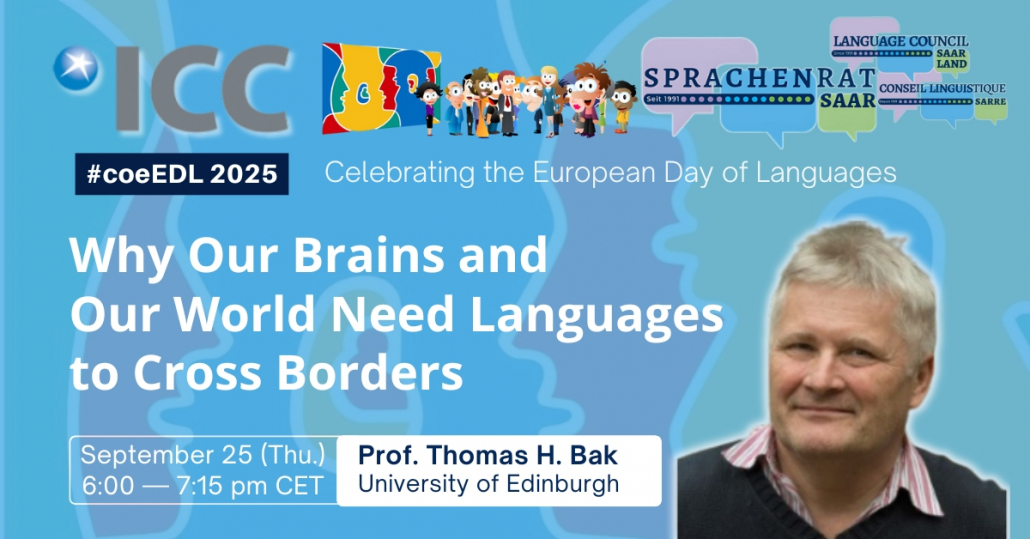
Prof. Thomas H. Bak | Why Our Brains and Our World Need Languages to Cross Borders
September 25 (Thu) 2025 | 6:00-7:15 pm CET
read more
Abstract:
In this talk, I will argue that human language is likely to have developed in a multilingual context and therefore, speaking several languages can be considered as the natural state of human mind, brain and society and the most natural form of mental exercise. This includes not only classical cases of children growing up bilingually, but also learning and using new languages across the whole lifespan. This multilingual default assumption offers an explanation for a wide range of recent research findings, from positive effects of even short periods of intensive language learning on attention to a delayed onset of dementia and a better cognitive recovery from stroke in older bilinguals. The cognitive and clinical results are further supported by converging evidence from other methodologies, including neurophysiology and neuroimaging. In addition, language learning can provide, even in the case of online delivery, a valuable source of social interaction. However, vibrant multilingualism is not only a matter of personal choice and preference. It needs the presence of different languages in our environment and their appreciation in society. I will highlight, therefore, the fundamental difference between genuine crossing borders through multilingualism and its opposite: a neo-colonial monolingual globalisation.
Bio:
Professor Thomas H. Bak
Personal Chair of Cognitive Science of Language and Multilingualism
University of Edinburgh, School of Philosophy, Psychology & Language Sciences (PPLS)
Born and raised in Cracow, Poland, Dr Thomas Bak studied medicine in Germany and Switzerland, obtaining his doctorate with a thesis on acute aphasias (language disorders caused by brain diseases) at the University of Freiburg im Breisgau (Germany). He worked clinically in psychiatry, neurology and neurosurgery in Bern, Berlin, Cambridge and Edinburgh, with a particular interest in the relationship between language, cognition and motor functions. In the years 2010-2018, he was president of the World Federation of Neurology Research Group on Aphasia, Dementia and Cognitive Disorders (WFN RG ADCD). In recent years, his work focused on the impact of language learning and multilingualism on cognitive functions across the lifespan and in brain diseases such as dementia and stroke. His studies include a wide range of populations, from children to elderly, and from Scotland, through India to China and Singapore. Not surprisingly, in his free time, Dr Bak particularly enjoys … learning languages.
Thomas shares insights and engages with global audiences on X (formerly Twitter) under the handle @thbaketal.
Related links:
Nik Peachey | Prompting for AI-Mediated Autonomous Teacher Development
June 26 (Thu) 2025 | 5-6 pm CET
read more
Abstract:
With the increased use of generative AI to do many of the tasks we have long associated with teaching and learning, there is a genuine concern that rather than supporting and developing learning and understanding AI may be used in a way which is negating the need for it. In this session Nik will look at an alternative method of prompting and how it can lead to deeper cognitive engagements and better metacognitive understanding.
Nik will demonstrate and share a number of prompts that are specific to teacher development that participants can try out and evaluate for themselves.
Bio:
Nik Peachey is an accomplished educator, author, and learning technology consultant renowned for his expertise in integrating technology into education. With over 30 years of experience in the field, Nik has become a prominent figure in the realm of digital learning and teacher professional development.
Having taught in various educational settings across the globe, Nik possesses a deep understanding of the challenges and opportunities faced by teachers and learners in the digital age. His passion for exploring innovative approaches to enhance teaching and learning has driven him to share his knowledge through numerous publications, workshops, and presentations.
Nik’s work has been recognised internationally, and he has received several prestigious awards for his contributions to the field of education in including two British Council Innovations Awards. He continues to inspire and support educators by sharing his expertise, exploring emerging trends in education technology, and advocating for the transformative power of technology in teaching and learning.
His books and teaching materials are available from: https://payhip.com/peacheypublications
You can find out more about what he shares at:
LinkedIn: https://www.linkedin.com/in/nikpeachey

Russell Stannard | Key AI Technologies that are impacting Language Education
March 26 (Wed) 2025 | 5-6 pm CET
read more
Asbtract:
In this highly practical talk, Russell will demonstrate some of the key AI tools that teachers in primary and secondary language education are using. The focus will be on free tools that can save teachers time and make lessons more engaging and student centred. Russell frequently reviews and evaluates a huge number of AI tools, often advising software companies in the development of their products for the language market. If you are looking for practical ideas that you can immediately bring to your teaching and learning then this is the talk for you.
Bio:
Russell Stannard is a multi award-winning Educational Technologist and founder of www.teachertrainingvideos.com. He has more than 80,000 subscribers on his YouTube channel. He received awards from the British Council ELTONS, the Times Higher and the University of Westminster for his work in the use of ICT in education. He trains language educators in the use of technology to enhance teaching and learning. His focus is on the use of technology outside of the classroom to extend learning options for students but he has also worked on the development of blended learning delivery and more recently AI. He has presented in more than 50 countries.

Rob Williams | Decolonising the Curriculum – what does this mean for language teaching?
March 7 (Fri) 2025 | 5-6 pm CET
read more
Asbtract:
In many institutions in the English-speaking world from the British Council to universities and schools, there has been a growing emphasis on ‘decolonising the curriculum’. But what does this mean? Are we already doing this in our schools or is there more we can do? This talk looks at how the choices of texts, of pictures and of sample sentence models can reinforce a cultural hierarchy and cultural stereotypes. It asks questions about how we can increase the range of voices and perspectives that we expose our students to. Can we enable them to be international and intercultural communicators using English and not just people who are prepared for communication in specific target countries such as the UK or US. In decolonising our input can we also enhance students’ intercultural competence as well as their language ability? Is there a trade off between providing a wider range of input sources and diluting a standardised form of language that an early learner will need?
This webinar raises these questions within the context of English and asks if they are applicable to other world languages or to the teaching of refugees and migrants.
Bio:
Rob Williams is a Principal Lecturer at the University of Westminster in London, where he is course leader for the MA International Communication, Liaison and Advocacy as well as teaching intercultural communication on the MA TESOL. He also leads undergraduate modules on intercultural communication, language in the public space, professionalising international communication, mediation and two course on teaching and education. His interests revolve around communication in its many guises.
Please note that a certificate of participation will only be issued upon request to ICC members. A nominal fee applies for non-members. Additionally, the premier webinar recording will be made available exclusively to ICC members. We encourage you to consider becoming an ICC member to enjoy these and many other benefits.

Alan Maley | Using Wisdom Stories and related inputs for Continuing Professional Development.
January 23 (Thu) 2025 | 5-6 pm CET
read more
Outline:
Alan Maley will present a number of ways to engage teachers in in-depth discussion as part of their continuing professional development. This will include using Wisdom Stories, poems, quotations, anecdotes from experienced teachers and episodes from non-specialist books about being a teacher.
Bio:
Alan Maley has been involved with ELT for over 60 years. He has lived and worked in 10 countries worldwide, including China, India, Ghana, Singapore, Malaysia, Vietnam and Thailand, as well as in Yugoslavia, France and Italy. He has published over 60 books and numerous articles. He is a past President of IATEFL (1988-92). Now retired, he currently runs an international creative writing group: Worlds into Words.
