2025 ICC-Languages Conference
Redefining Language Education – Technology, Accessibility and Empowerment.
Larnaka, Cyprus (May 9 to 11) on-site

Redefining Language Education – Technology, Accessibility and Empowerment.
Larnaka, Cyprus (May 9 to 11) on-site


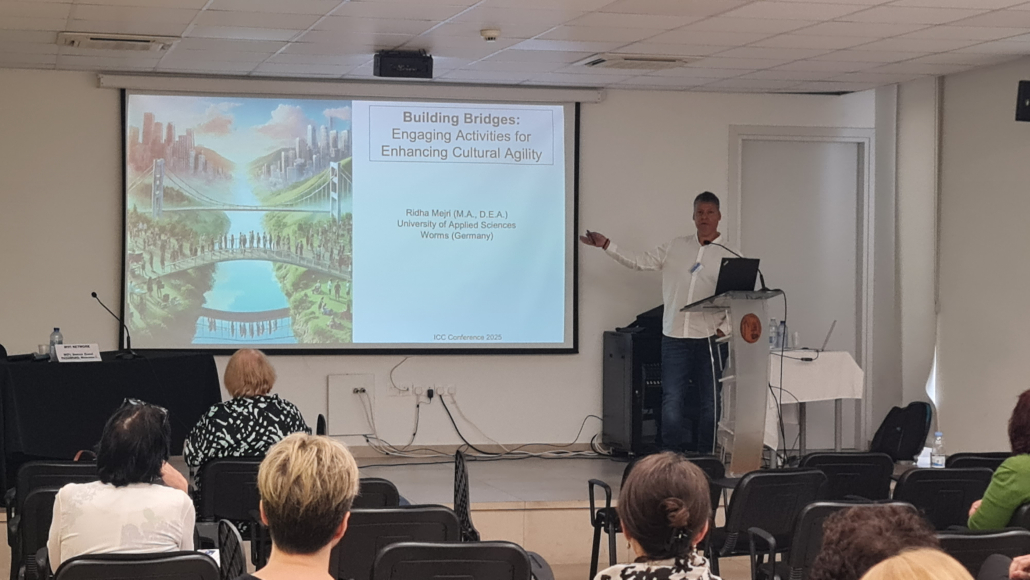
ICC-Languages hosted its 2025 Annual General Meeting (AGM) and Conference from May 9 to 11 in the beautiful city of Larnaka, Cyprus. Under the theme “Redefining Language Education: Technology, Accessibility, Empowerment,” the event brought together educators, researchers, and policy leaders to explore the future of language learning in an era shaped by digital innovation.
Held at the Multi-functional Center for Social Activities and Welfare of Larnaka Municipality, the conference featured over 20 sessions, including a keynote speech, workshops, and a panel discussion. Renowned linguist Professor Kurt Kohn opened the event with a keynote on developing intercultural communicative competence through AI-enhanced pedagogy.

Over 70 participants from 24 different countries attended the conference. Throughout the weekend, attendees engaged with cutting-edge topics such as AI in language teaching, working in international teams with the help of AI, the integration of AI into Higher Education, and ethical issues concerning the use of AI. Other topics included gamification when teaching Greek, language learning for migrant workers, and integrating conversational agents into the classroom. ICC Co-Chairs, Myriam Fischer and Tatjana Kovac, alongside Mayor Andreas Vyras, welcomed participants from across Europe, North Africa, Asia, and North America, affirming Cyprus’s role as a hub for intercultural dialogue and educational innovation.
The event concluded with a walking tour of Larnaka’s historic city centre, reinforcing the conference’s intercultural spirit.




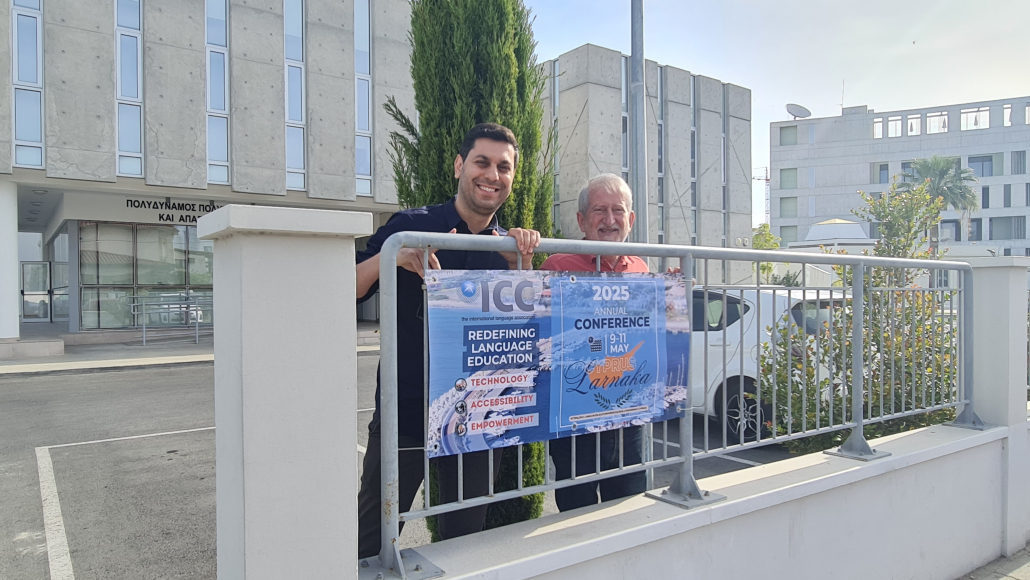


Multi-functional Center for Social Activities and Welfare of Larnaka Municipality
Address: Faneromenis 62, Larnaka 6025, Cyprus
This conference serves as a platform for the exchange of innovative ideas, the dissemination of research findings, and discussions on the challenges and opportunities in language education.
Scholars and practitioners will gather to explore the conference theme, fostering discourse on language teaching and learning.
Relevant information and updates, including the conference programme, speaker profiles and registration details are available on this webpage.
As the world becomes more interconnected, the field of language education is experiencing a profound transformation. The rapid advancement of technology, alongside a growing demand for more inclusive and accessible learning, is reshaping how languages are taught and learned. This conference explores how these factors are influencing language education and paving the way for a more equitable, engaging, and effective learning experience.
The conference theme encompasses the following key topics and more:
Technology has revolutionized language education, offering diverse tools such as AI-driven learning platforms, mobile apps, and virtual classrooms that provide flexible and personalized learning experiences. From adaptive learning systems to immersive environments using virtual and augmented reality, participants will explore how technology can bridge gaps and foster language acquisition in innovative ways.
Inclusive education is more critical than ever, and language learning should be accessible to all, regardless of socio-economic background, physical disabilities, or geographic location. This section highlights strategies and tools designed to create inclusive curricula and resources, including accessible e-learning platforms, assistive technologies, and strategies to promote language learning among underserved communities.
Language is a key to cultural exchange, global mobility, and personal empowerment. The conference will discuss how language learning fosters individual growth and enhances professional opportunities, empowering learners to engage in global discourse. It will also focus on the role educators play in empowering learners, with special emphasis on learner autonomy, cultural sensitivity, and lifelong learning skills.
Looking ahead, what are the emerging trends shaping the future of language education? The Conference explores the evolving role of teachers in tech-enhanced classrooms, the ethical implications of AI in language teaching, and the global movement toward multilingualism. The discussion will address both the opportunities and challenges that come with these changes.
English Department, University of Tübingen (Germany)
 Kurt Kohn is Emeritus Professor at the University of Tübingen, Germany. He has decades of experience as a researcher and teacher in English and Applied Linguistics. His current areas of interest include English language teaching and learning, intercultural communicative competence development, Global Englishes and English as a lingua franca, pedagogical lingua franca immersion, intercultural virtual exchange, and language teacher education.
Recent publication:
ORCID ID: 0000-0002-5125-6271
Abstract
Have you ever wished to reach out beyond your foreign language classroom to enable your students to acquire and develop communicative competence in English as a lingua franca (ELF) for intercultural contact and interaction? In my talk, I will outline a socio-psycholinguistic model of intercultural ELF communication that places speakers at the centre as responsible agents of their own communication and learning. Key elements include speakers’ own REQUIREMENTS of communicative and communal success, their MY English REPERTOIRES, their natural CAPABILITY for communication, and their communicative ELF PERFORMANCE. Against this backdrop, I will discuss the pedagogical affordances of virtual exchange scenarios based on telecollaboration tools (e.g. videoconferencing, virtual worlds, or Padlet) and AI-enhanced conversations. My focus will be on ‘flipping’ authentic communication activities from within the classroom to an intercultural space outside the classroom. The objective is to make it possible for students of different linguacultural backgrounds to meet and communicate with each other using their shared target language as a pedagogical lingua franca. I will conclude with observations from European case studies concerning means of pedagogical mentoring that help LEARNERS of English develop their sense of agency and satisfaction as (more) emancipated SPEAKERS of English. The approach described is also applicable to the teaching and learning of foreign languages other than English.
Expert Language Education Consultant
 Michael Carrier is a former British Council Director with over 40 years experience in language education as a teacher, trainer, author, and director.
Michael holds an MA in Applied Linguistics and an MBA, and his former positions include CEO of International House World; Director, English Language Innovation at the British Council; Executive Director of Eurocentres USA and Managing Director of Highdale Consulting.
He is currently serving on a number of boards in US, UK and EU.
He has written many ELT coursebooks and articles, and his latest book is ‘Digital Language Learning and Teaching’.
Abstract
My talk will address the ethical and responsible use of AI in ELT and introduce a practical and accessible Guide to AI Ethics Policy for both teachers and students.
Many teachers are using AI in the classroom or to prepare lessons, and they believe that AI tools can enhance their teaching and the learning success of their students. It’s important that we develop clear guidance for teachers and learners to address the ethical and responsible use of AI and to avoid potential cheating.
School ethics policies can advise on the ethical use of resources by providing guidance for students on using AI ethically in their assignments and assessments. I will explain the need for such a guide to maintain standards in teaching and learning, and to help schools create effective safeguards to support learning success.
My talk will share best practices by giving examples of Ethics Policies developed by universities, companies, and governments, and I will show how this approach can be adapted to the language education context.
I will present a 10 Step Guide to AI Ethics for Teachers, developed in conjunction with the TIRF Foundation in the US, and explain how to incorporate this guide into Teacher Development. Additionally, I will share a 10 Step Guide to AI Ethics for Learners and explain how to integrate this into learner training in the classroom, as well as how to utilize its principles in the language assessment process.
There will be a Q&A session to address delegates’ questions and concerns, and the Guides can be downloaded immediately.
Business Communication Consultant
 Ian McMaster is a business communication consultant, author, and journalist. He was the editor-in-chief of the business communication magazine Business Spotlight from 2001 to 2021 and editor-in-chief of the general English magazine Spotlight from 1995-2003.
Ian is a former coordinator of the IATEFL Business English Special Interest Group (BESIG) and a regular speaker at international conferences.
He is the co-author with Bob Dignen of numerous business English publications. His latest book (completely in English despite the German title) is Trainingsbuch Business English – Kommunikation und Zusammenarbeit in internationalen Teams; Haufe.
Abstract
Working in international teams very often involves using English as a lingua franca — and inevitably involves collaborating with people who have different communication styles, preferences and working styles. This can be highly stimulating, but it can also be frustrating and can lead to misunderstandings, communication breakdowns and inefficiency in teamwork.
In this workshop, we will explore some ways in which generative artificial intelligence (ChatGPT and co.) can help team members and team leaders to reflect on their attitudes when working internationally, to communicate and collaborate more effectively and, ultimately, to achieve better business results.
The workshop will not presume that participants are experts in using AI but will instead brainstorm, present and discuss ways of using the technology.
Participants will be asked to brainstorm reasons for using AI in business generally and, more specifically, in international teams. Suggestions for specific tools will be collected and discussed.
We will also look at and evaluate the ways that ChatGPT claims to be able to help international teams to improve their communication skills and, as a result, to work more effectively.
Finally, we will brainstorm a set of seven top tips for better international communication. We will compare the tips suggested by the presenter, those from the workshop participants and those provided by artificial intelligence. Who will come up with the better tips?
in alphabetical order

(closed on 28 February)
Presentation Types: Talk and Workshop (Each with a duration of 45 minutes, inclusive of a 10-minute Q&A session.)
Abstract Requirements:
Bio:
Abstract Review Criteria:
Note: This timetable follows the Eastern European Summer Time (EEST) (UTC+03:00)
Board Meeting & Conference Venue: Multi-functional Center for Social Activities and Welfare of Larnaka Municipality (Address: Faneromenis 62, Larnaka 6025, Cyprus)
| 17:30 | ICC Board Meeting |
| 19:00 | Welcome Dinner Reception (Venue: DSTRKT) Address: Ermou 82, Larnaka 6023, Cyprus |
Each session consists of a 30-minute presentation, a 10-minute Q&A, and 5 minutes allocated for room changes.
| 08:45-09:30 | Registration | |
| Room 1 | ||
| 09:30-09:45 | Welcome ICC Co-Chairs: Myriam Fischer & Tatjana Kovac Larnaka Mayor: Andreas Vyras |
|
| 09:45-10:45 | Keynote Speech: Developing Intercultural Communicative Competence through (AI-Enhanced) Pedagogical Lingua Franca Immersion Kurt Kohn, Professor Emeritus of Applied English Linguistics English Department, University of Tübingen (Germany) Moderator: Thomas Tinnefeld |
|
| 10:45-11:00 | Coffee Break | |
| Parallel Session (Room 1) | Parallel Session (Room 2) | |
| 11:00-11:45 | Invited Talk:
No Cheating – a Guide to Ethical AI Use in Language Teaching Moderator: Helen Bulluck |
Workshop (in Greek & English):
Gamifying Greek: How Digital Tools Can Make Learning Greek Fun and Effective Moderator: Valentinos Filippou |
| 11:45-12:30 | Talk:
Empowering Migrant Workers through Work-related Second Language Learning for Labour Market Integration and Participation Moderator: Myriam Fischer |
Talk:
Enhancing Oral Presentation Skills Through Generative AI Moderator: Ian McMaster |
| 12:30-13:45 | Lunch | |
| 13:45-14:30 | Talk :
Keeping up with the Gen Zs: a Sceptic’s Guide to Adapting Existing Teaching Materials for an AI-Savvy Audience Moderator: Ian McMaster |
Talk:
Bridging the Gap in Oral Proficiency: Pedagogical Integration of Conversational Agents Moderator: Tatjana Kovac |
| 14:30-15:15 | Talk:
Fostering Entrepreneurial Competences and a Sustainable Entrepreneurship Mindset in Higher Education English for Specific Purposes Contexts Moderator: Ian McMaster |
Workshop:
EUROLTA – European Certificate in Language Teaching to Adults: Professionalisation Pathways for Aspiring Language Teachers Moderator: Myriam Fischer |
| 15:15-16:00 | Workshop:
Fostering a Multilingual Mindset – Strategies for Promoting Multilingualism in Education Moderator: Ian McMaster |
Workshop:
AI in Language Teaching and Learning Moderator: Damian Fäh |
| 16:00-16:30 | Coffee Break | |
| 16:30-17:15 | Talk:
Integration of Artificial Intelligence into Higher Education: Perceptions of Students and Educators Moderator: Thomas Tinnefeld |
Workshop:
AI Chatbots as Mediation Simulators: Enhancing Cross-Cultural and Cross-Disciplinary Communication in ESP, Exemplified by Engineering Moderator: Damian Fäh |
| 17:15-18:00 | Talk :
Building Bridges: Engaging Activities for Enhancing Cultural Agility Moderator: Helen Bulluck |
Talk:
Teaching and Learning Dynamics in Online EMI Environment Moderator: Tatjana Kovac |
| 19:00 | Dinner (own cost)
Venue: Militzis Tavern (Address: Piale Pasa 42, Larnaka 6028, Cyprus) |
|
| 08:45-09:45 | ICC Annual General Meeting | |
| 09:45-10:00 | Break | |
| Parallel Session (Room 1) | Parallel Session (Room 2) | |
| 10:00-10:45 | Invited Talk:
Working in international teams: how can AI help? Moderator: Helen Bulluck |
Talk (in Greek):
GREEK LINGO BOX: Back to Face to Face? Myths about Language Games and a Fresh Idea for Board Games Moderator: Valentinos Filippou |
| 10:45-11:00 | Coffee Break | |
| 11:00-12:30 | Panel Discussion: Redefining Language Education – Technology, Accessibility and Empowerment Coordinator: Thomas Tinnefeld Moderators: Thomas Tinnefeld & Michael Carrier Panellists:
|
|
| 12:30-12:40 | Closing & Farewell | |
| 14:00-16:00 | Guided Walking Tour (own cost) | |


We are pleased to share a list of recommended hotels for your stay during the 2025 ICC-Languages Conference. Special rates have been arranged for participants. Please mention the ICC Conference when booking to avail of the discounted prices.
This hotel is recommended for its effective communication and convenient location, with several conference organisers selecting it for their stay.
We are pleased to share a comprehensive guide provided by the Larnaka Tourism Board, featuring essential information, QR codes, and links for easy access: GUIDE TO LARNAKA FOR VISITORS.pdf.
 For additional recommendations on attractions and activities, visitors can also explore the website article “Weekend in Larnaka“, which offers curated suggestions and useful links.
As part of our social activities, the conference organising committee has arranged a guided tour with a local expert on 11 May as a post-conference event. Participants are welcome to join at their own cost. For more details and to register, please refer to our registration form for social event activities.
Most places are easily accessible on foot, with key locations just 5 to 10 minutes away.
For transfers from Larnaka International Airport to your hotel (10-minute drive), here is some useful transport information:
Website: www.publictransport.com.cy
Phone: 1416 (local calls only)
Email: info@publictransport.com.cy
Taxis are available outside the airport for direct transfers to your hotel or other destinations.
Website: www.hermesairports.com
Phone: 7777 8833 (local) | +357 2512 3022 (international)
Email: info@hermesairports.com | customerservices@hermesairports.com
The conference fees are as follows:
The conference fee includes an e-certificate of participation, the welcome reception dinner on 9 May, refreshments during coffee breaks and lunch on 10 May, and refreshments on 11 May.
You need to load content from reCAPTCHA to submit the form. Please note that doing so will share data with third-party providers.
More InformationYou are currently viewing a placeholder content from Turnstile. To access the actual content, click the button below. Please note that doing so will share data with third-party providers.
More InformationYou need to load content from reCAPTCHA to submit the form. Please note that doing so will share data with third-party providers.
More InformationYou are currently viewing a placeholder content from Facebook. To access the actual content, click the button below. Please note that doing so will share data with third-party providers.
More InformationYou are currently viewing a placeholder content from Instagram. To access the actual content, click the button below. Please note that doing so will share data with third-party providers.
More InformationYou are currently viewing a placeholder content from reCAPTCHA. To access the actual content, click the button below. Please note that doing so will share data with third-party providers.
More InformationYou are currently viewing a placeholder content from X. To access the actual content, click the button below. Please note that doing so will share data with third-party providers.
More Information